
Don't hate the media, become the media. Jello Biafra
Than Hussein Clark
Mother has arrived
Director, Designer & Writer: Than Hussein Clark
Producer: Andy McCredie
Dramaturg and Script Editor: Laura Schuller
SFX Makeup Artist: Aurora Beadle (KM Effects)
Cast: Lewis Blomfield, Benedict Wishart
Images © Maya Yoncali / Kaasm-Aziz
SEPT, 21, 2025

MOTHER HAS ARRIVED
World Premiere
Corvi-Mora Gallery
Mother Has Arrived by Than Hussein Clark, his six-and-a-half-hour performance and installation, has its World Premiere at Corvi-Mora gallery in London as part of the group show "Anal Peace" with David Lieske.
Mother Has Arrived is produced by The Director’s Theatre Writer’s Theatre, the resident company of London Performance Studios.
Hi Than, thank you for taking the time time talk with us Than. I have been spending too much time doom scrolling, the news never gets better.
Christ alive. I've never been an alarmist before, but over the last six months I don't know what the f*ck is gonna happen. It's really, really something.
What made you want to bring Mother Has Arrived to Corvi-Mora Gallery?
Mother Has Arrived is made for a gallery, and made to challenge, as much as possible, the terms by which performance in a gallery space can happen. They’re usually in short, looped intervals. The attention economy of the gallery is very different than that of a theatre and I tried to do it in such a way that allowed the story to be told in 30-minute episodes. I'm very pleased and honoured that people have decided to stick it out for six hours, which is wonderful because the piece does have a beginning and an end. It traverses a certain timeline and story which is why it starts when the gallery opens and finishes when the gallery closes. It’s through the working hours, and the glass box acts as a vitrine for the play, in a museological sense, it contains the energies of the play for the gallery.
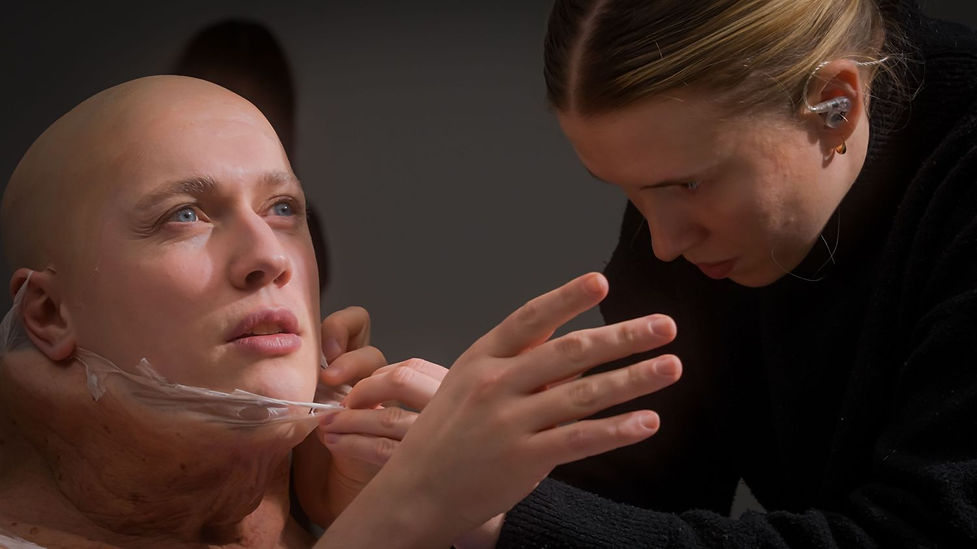
I noticed, as the prosthetics are slowly put on Lewis Blomfield, a change gradually overtakes him as he turns into Martha.
That was calibrated, hour by hour, how much of her Lewis would embody as the prosthetics are applied. That's why the glass changing and light shifts is so important. A slight aside, one of things I find fascinating, and I don't know if it's just a gay thing, is watching a woman putting on her makeup or makeup tutorials. There’s a reason people love to watch those things. With the glass box, if the attention is on Benedict, especially in the third hour, when he suddenly finishes one of the screen tests and the light changes back to Lewis he'll look completely different.
I want to ask about the political aspects of Mother Has Arrived. We seem to be faced with an unimaginable political landscape and due to the way you explore your mothers personal political history, it's as though we should have learnt from this past, but we haven't.
I have to be honest with you, the political side of the piece came about in the making of it. We worked for two months last year putting the skeleton of the show together, then we ran longer sections of it. Suddenly I thought what we're actually doing is telling the story of my mum’s life from the beginning to its decline, she’s 84. What we've ended up doing, for lack of a better word, was to tell the story of the American century.
People of my parents' generation, at least in America, really believed politics worked, whereas I grew up never believing this to be the case. I never had a moment thinking that the system was functioning. However, people of my parents' generation, particularly white cis, heterosexual people in New England, grew up believing in this idea of American exceptionalism. The promise of democracy and meritocracy, of all of those things. And I became increasingly interested in the extreme friction that they were experiencing when they were seeing all of those things that they so radically believed in.
My dad died in 2023 and he would be apoplectic now. It would be such an attack on his moral frame of reference in which he understood himself in the world. I personally think the issue, at least for the centre-left, is that they are still stuck in the politics of the past and trying to function under the old rules. Since 2016, the real problem is that the right have become experts in the new media landscape and have taken on the legacy of post-structuralism. And the left is reeling in a way. I think we're at a tipping point, where the old rules don't apply, and we're going to have to completely re-evaluate and re-imagine the terms of political engagement to be effective.
How did Mother Has Arrived come about, what did you want to explore with this piece?
I began with wanting to investigate the cliche of gay men’s obsessions with their mothers. I've done a lot of work over the years where I've inhabited those problematic cliches to see what happens. Politics was an important part of my mother's career and my parents' interests and engagements – one could say by the end of their lives they were so much a part of the system that their politics were compromised. Which we touch on at the end of the piece with their supporting for Biden, even though my mum was the first person to come out for Bernie Sanders in the previous election. We started by interviewing my mother for two weeks about her life. And then we looked at including other found audio of political or public events that my mum referred to, creating this audio archive of found YouTube material, whether that was movies, political events, or random stuff like the Metropolitan Museum of Art, things like that.
Through these interviews I was initially thinking to myself that this is really banal. And because my mother is a trained politician, she doesn't really say much, she’s really good at not exposing herself. I would say in the 25 hours or so of interviews that I did there is probably four or five moments where I felt she was genuinely honest. Also her memory is compromised now. It's not terrible, but it's compromised. As we got going she wasn't saying anything interesting. There was stuff I was being reminded of but there wasn’t anything I thought what great drama is made from. I knew the reasons why I was interviewing her, but I was left wondering how I was going to make a play out of this boring nonsense. Then I thought maybe it gets a little bit more interesting if we cut to this other found footage. During this process was realising there was a period of time during, when prosthetics are being applied, where Lewis can't speak. In the timeline, one of the many timelines of the piece, we realised that this hit right at the end of the 60s, which is when my parents met.
The relationship between gay men and their mothers, particularly with Psycho, shows how ancient that relationship is, it’s not a modern construct, it’s a trope that goes back decades.
Particularly in the 40s and the 50s there's "all the gays are obsessed with their mums" and are "communists". One would hope that really, it is a kind of a trope. That once you start looking at it, it appears time and time again in different formulations. Oftentimes though what I'd say is it's a sign of pathology, where actually it is also just love. Because for a certain generation of queer people, it was always the mums, most of the time, that stood up for us.
When did you realise you wanted to include your father in the piece?
I recalled before my dad died he was engaged in one of these ghostwritten memoir projects. And this resonated because it's what I had done with my mom a few months earlier. I found the written transcripts and I wondered if they still had the recordings, I contacted the company and they did. So about six weeks into the piece in earnest we now had 28 hours of my dad talking from beyond the grave.
Did this inclusion of your father impact the journey of the piece?
It was interesting how their stories diverged for the first part of their lives, from the moment they met and got married, the transcripts are almost the same. They talk about all the same stuff, but from different perspectives. I had the idea that Benedict would play my dad at some point and then started cutting a version of all the transcripts where we turned the interviews into a of stream of consciousness monologue. As we got to seeing it in chunks the politics became clearer, especially as we hit the time of my mom's life where she was engaged with politics, we couldn't help but talk about politics. Watching the piece from the start of hour one to the start of hour five, this larger sense of watching history unfold in front of you became very clear. And we made choices as went along to highlight this at certain points. Once we saw what was happening, that became a key focus of the dramaturgical work.
How did you feel about including yourself in the piece?
I was avoiding having to put myself in the piece a first. I said to the actors at some point that they’re going to have to do me, I had no idea how to direct them to be me, so I gave them this as a secret project. I would block time for them to work on their own or with the voice or movement coach doing me. About seven weeks into it their secret project it needed to be revealed and when they did it I almost fell off my chair. To me this was the most embarrassing thing of all time, I was sat on a chair like a spider on cocaine. It was strange. I did a set of recordings with the dramaturg, Laura Schuller, where she asked the same questions that my dad and mum were asked. We had my thoughts on the same events and we started cutting those into the text from 1981, which is the year that I was born.
When you watch the piece from the start to finish you see an incredible connection between Benedict Wishart and Lewis Blomfield, particularly towards the end. How did you go about casting them?
I'm biased, obviously, but I think they do an absolutely extraordinary job. We auditioned about 20 people, had a call back, and at that point all we knew was who’s going to be turned into my mum. The voice specialist that's been helping us, Joe Windley, the ex-head of Voice of RADA, said it's like watching two actors both play Hamlet. That’s the level we’re requiring of them. I knew Benedict previously, I'd worked with him a little bit in the past. And Lewis I didn't know at all, but the dramaturg knew him from his work at this alternative comedy night called Pinata, and knew he was very good at voices, impersonations, and imitations. There was going to be another person doing the makeup, Aurora Beadle (KM Effects), to help bridge the gap between the performer and the prosthetics, who couldn't be an actor. Over 12 weeks of rehearsal in the fall we began with improvisations from the YouTube clips. Out of that came the two characters, the dramatic personas that they each play, the director and the actor, Essex and Exeter.
Benedict and Lewis did a lot of work with Joe Whitley, who's an absolute genius at listening. We worked a version of this process called verbatim theatre, where the actors have earpieces so they listen to recordings. When Lewis is listening to my mum, he actually hears her talking in his ear, and he repeats it as exactly as he can. They worked a lot on that process, and developing their vocal technique, responding to the audio, which they continue to do now, and there are sections of the play where they're doing structured improvisations. It's very lucky they've become great friends through the process. And I think they have an extraordinary connection.
For an actor, Hamlet is supposed to be the big one, and here you have two actors embodying the text so completely, and within the confines of the space, is genuinely stunning.
I have to say, oftentimes the condition which actors have to work in are not always conducive to their talent. The average amount for rehearsal in this country is about three to four weeks. We spent 18 months on this and I think it shows, this is not to diminish Benedict and Lewis's extraordinary talent in any way. I think if you give talented people the correct conditions, they can do something extraordinary, they’re incredible actors. What actors are often asked to do in popular, or commercial theatre is usually about 30% of what they could do because of the constraints of the material they're given. I'm a great lover of actors. It's absolutely the most sublime and difficult art form of all time, and I love to create work that's allows actors to act with a capital A and show what they can do.
Any apprehensions about working with them on such a personal project?
I had to abstract the material and myself a little bit. It was strange at times because I found myself talking about things that I normally never talk about in the rehearsal room or share with actors. There were loads of strange moments where I forgot how much Benedict and Lewis were starting to know about my life or my family's life. Eventually they went to America to visit with my mum for three days and saw where I grew up.
In March of this year we recorded the open rehearsals and had them transcribed, out of these open rehearsals we ended up with a 580 page script. We ran a process called etudes, which are structured improvisations, about 65 in total, that focused on Exeter and Essex's' pasts, stuff that isn't technically in the play. Everything that happened to these two characters before the play started. How they met in LA. The other movies they did. Why he has a Polaroid camera. Why he gave him cologne at one point. Going from the characters' lives till the movie was being made, using the transcribed recording of the open rehearsals as if it was a set dramatic text. Between May to mid-July we rehearsed mostly the devised sections but with some of the verbatim parts as well. Using a technique called Active Analysis, from Stanislavski Opera Dramatic Studio, which embodied a textual analysis approach that I've been very interested in for the last several years. We were working off the audio in July, and I think they've become wonderful.

I have to ask about "Kenneth"?
About 40 or so minutes in to the piece, during one of the first Hitchcock scenes where they do a scene from Hitchcock's Rope, there's a line where he says, “who would you have preferred? Kenneth?” During one of the rehearsals Benedict made the choice to refer to Aurora in that context as Kenneth, and it kind of stuck. There's six scenes from Hitchcock films in the play, and steal one or two elements from each of those scenes. From the first one we got Kenneth's name, and there's some other details that echos out the Hitchcock material in the rest of the text.
What is it about theatre that connects with you so much as an artist?
I was talking to my friend, David Lieske, who did the paintings and the slideshow work that's also in the exhibition space. He's been a great friend and collaborator over the years. He jokes that he hates the theatre. But theatre, though it's often seen as outmoded in the face of A.I., the experience of listening to real people say real things has begun to matter more than it ever did.
I was definitely one of the people in 2016, which I consider the watershed year around the world, I was like, okay, time's up. There's something about the presence of the urgency of the present that requires a change in direction in how we talk, how we make art, how we talk politics, how we make politics.
That’s what makes theatre so important right now, it takes away technology and keeps it analogue, allowing all our senses to feel something real. Having this production inside a gallery allows people, who are more used to traditional theatre, to interact with the piece in a different way. Hopefully, if people aren't afraid to write and to create, we will move a little bit more analogue, and will re-engage with culture.
Did being based in the UK give you a different perspective on how you went about creating Mother Has Arrived?
One of my great heroes was the American writer Henry James. At the end of his life he wrote a novel called The Ivory Tower, when he went back to America after expatriating and writes about how America has changed from a distance. He writes about America, not as an American anymore, even though he was born an American, and I find some common cause with that. If I speak totally frank with you, if we were to come back to the show, which I hope we will, I'd like to try to expand the geography of it a little bit more towards the end, where it becomes more global. A certain idea of America is becoming anachronistic, right? A certain idea of the West is becoming anachronistic as well. As I talk about in the play, what I would refer to as classical homosexuality has become anachronistic.
America's role in the world, with all the problems of it, all of whatever that was, is being radically transformed. Both in the public imagination and in political practice. And I think you could say the same thing about the UK. I think that we are looking at a revision of the world order. Who knows what the new order of things will be, but it's certainly going to be different.
Sometimes I am really conscious about what I write or what I post in case it gets flagged. People now put an asterisk over certain letters otherwise it could be it could be flagged. We're facing it a lot, particularly in America, this idea of censoring free speech.
I'm not a writer so I can only imagine the kind of the ways in which those things are affecting people who are producing a lot of content, but never before have we had people scared to go to America. You have people screaming free speech, but when somebody that isn't on their side they want them cancelled.
Unfortunately, depending on where you sit in politics, I always find those on the left cannot articulate the logic from the right. And for some reason, the right always gets a higher platform.
It begins with small things. But if we like go back 10 or 15 years ago, suddenly on International Women's Day, there would be people going, what about men's day? I'm old enough to remember certain Republican politicians in America saying gay people should be put on an island and quarantined in the face of HIV. The same politicians 25 years later saying they have no problems with gay people as long as their rights as a white Christian are respected. What has begun to happen is that the right has taken on the legacy of postmodern relativity and also the philosophical games around poststructuralism.
This link between A & B and what it means is not stable, and in the face of that, the left has retreated into a reactionary version, affect theory. They want to speak their truths and, in the face of opposition, they double down on what they understand to be the truth of their own experience. Speaking only from the personal.
But in the face of the right's manipulation of science, any retreat into truth or urgency is going to fail, unfortunately, because the right don't care. It is past that point. I'm starting to work on a Brecht play and part of my research focuses on Christian Evangelical right-wing women influencers. In the most recent Turning Points Conference, a lady gave a speech saying something along the lines that they used to run from culture, now they’re running the culture. I think that speaks to exactly what you're saying, that the right is setting the rules of engagement, and we actually haven't found a way yet, to come back with them. Personally, I am still struggling to find the aesthetic means, the linguistic means, the philosophical means, that feels like the appropriate weapon in the face of what we're facing.
"...because I thought this was going to be my goodbye to performances in galleries, that it's reignited my interest."
I would argue that the left would have to try and out right wing the right wingers, like you said, truth doesn't matter. The more truthful you are, the less trusted you're going to be by the people you're trying to convince. So telling them the truth is irrelevant. Trying to stand up for what is right at the moment is also irrelevant.
It's a fool's errand, I couldn't agree more.
After leaving the show I did spend sometime thinking about my own mother.
I think there's something weird that happens with the show. Some of it is so hyper specific that it becomes somewhat universal, which I didn't anticipate. In my anxiety of these first round of interviews I was thinking this is just some banal, white people talking about their boring lives. Somehow, because of the skill of the actors and because it's not manipulated that it does resonate. Everybody has a mum, everybody's got a dad, everybody has weird family dynamics, all of that stuff. So I guess I'm pleased that it's making people think about their own parents.
Finally, what have you taken from this whole process?
I’ll be honest with you, it's still a little early to know completely, I have inklings of it. I would say I have a different interpretation of my parents' life together. I have more of an appreciation of what they might have both sacrificed to make a 50-year marriage work. Formally I've learned a lot, like working with the audio, I'd never done that before, and that opened up a whole series of questions for me going forward about whether I continue to use that technique in different ways. I think six and a half hours done in detail is a f*cking long thing to do. I'd be interested to spend as much time on something that was half as long to see what was possible. I've gotten more comfortable with things that are structured in slightly non-linear ways.
As we began with the question of doom scrolling, I'm left with a deep pessimism around the state of the world, unfortunately. Or I'm not sure how to respond yet, what is the right move? I'm definitely more and more convinced that we are in serious trouble.