
Don't hate the media, become the media. Jello Biafra
Miquel Barcelona Palau
Rojos
EDINBURGH FRINGE INTERVIEW | 2026
C ARTS | C digital
Images © Miquel Barcelona Company
Aug, 17, 2026
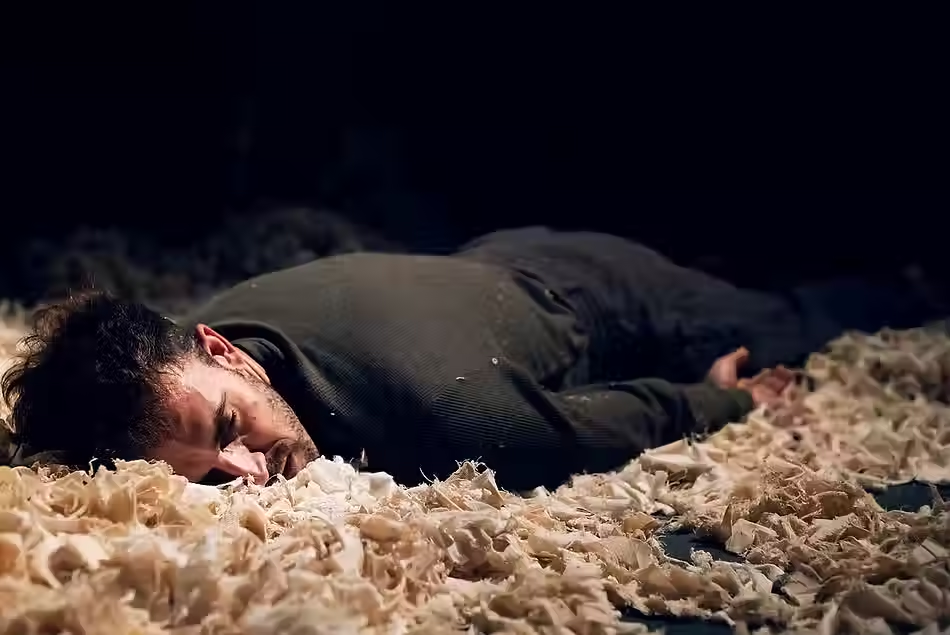
A moving piece of contemporary physical dance theatre drawing on testimonies of the Spanish Civil War. Cia Miquel Barcelona create a visceral piece which is as powerful as it is haunting. Rojos grew from a 2-year research project on the post-Civil War period. The language of dance allows the company to bring the period to life using the performance and research as a way to listen and learn about the past. The piece also seeks to highlight untold stories, making them visible to audiences for the first time.
Hello Miquel, thanks for speaking with The New Current ahead of the Edinburgh Fringe. What does it mean to you and your company to bring Rojos to the festival?
It is an opportunity to showcase the company’s work internationally and to keep the conversation going about the post-war period, memory, and the traces that conflicts leave on individuals and societies.
When you created Rojos, did you imagine it would have the impact it has had on audiences?
You never know what kind of impact your work will have on others. However, I have deep faith in the language of dance and its ability to spark reflection through the body. I also greatly value the experience the team has had engaging with people from very diverse backgrounds and performing the piece in locations steeped in historical and emotional significance.
What is it about this piece that has resonated so strongly with audiences?
Memory is a vehicle for transmission that connects with a very deep part of our collective and individual experience. I believe our bodies can become a canvas upon which the audience projects their own memories, reflections, and questions. If the piece helps prevent us from repeating the same mistakes, then it will have served an important purpose.
Can you tell me a little about how Rojos came about?
I realised I knew very little about the aftermath of the Spanish Civil War. Convinced that its consequences are still with us—and that it is an experience that can be universalised to other contexts—I decided to explore it through the body and the language of dance.
Did you have any concerns about creating a show that tackles such a difficult, historical subject?
My main concern was to avoid offering a single, definitive narrative. Dance has the ability to open up questions without imposing judgments. I wanted to harness that quality to give space to lesser-known stories—such as those of the so-called "public women" or the histories linked to the underground gay and artistic scenes during the Franco regime.
What did you want to express with Rojos, and do you think you succeeded?
I wanted to learn. I also wanted to create a work that would challenge us and force us to confront a complex part of our history head-on. The process profoundly transformed my understanding of this period, as well as my interpretation of the present. In that sense, yes, I think we succeeded.

Was it always your intention to use this piece as an opportunity to give voice to the forgotten voices of the Spanish Civil War?
That was something that took shape during the process. From the start, I knew I didn't want to reuse historical materials merely for illustrative purposes. Gradually, we found a way to approach the subject through voices and experiences that resonated with us in the present day.
During your research, was there anything about this period that surprised you—something you hadn't known before?
Practically everything. I realised, for instance, that many of the simplified narratives I had previously encountered failed to reflect the true complexity of events. I was particularly struck by the brutality of the Francoist repression, the families torn apart by the conflict, and the sense that many processes of reparation and reconciliation remain unfinished business.
How much has the central message of Rojos changed since the production premiered?
A work is always a living thing. Unfortunately, in a world where armed conflicts and political violence persist, many of the questions raised by Rojos remain entirely relevant. Contexts shift, and with them, so do interpretations of the piece.
When working on Rojos, how essential is the creative collaboration between you, Helena Gispert, Martí Güell, and Bea Vergés?
They are a fundamental part of the project. I can't imagine this piece without them. We are currently passing the work on to four performers from a younger generation, which makes me appreciate even more what each individual brings to the creative process. With Helena, Martí, and Bea, I feel supported, challenged, and valued. Thanks to them, I’ve also learned how to direct better.
Music, lighting, set design, and sound design are equally important to Rojos. What was the process like working with Carlos Martorell, Laura Clos, and Josep Sánchez-Rico to bring your vision for this production to life?
It was a deeply collaborative process in which each discipline engaged in dialogue from its own artistic perspective. We worked with concepts such as silence, the imprint, and the trace to build the piece's universe. Honestly, I believe it has been one of the most solid and enriching creative processes we have experienced together.
Where does your passion for dance come from?
I always say that I started dancing quite spontaneously when I was four years old. My parents supported me very naturally—without having any close connections to the dance world—and that was fundamental.
"I hope the people I work with speak as highly of me as I do of them."
To what extent did your early experience in musical theatre influence your desire to pursue choreography as a career?
I have always been interested in the voice as an extension of the body. In all the company’s pieces, we use the voice—both spoken and sung. I have great respect for the craft of musical theatre and for everything it gave me during my early training.
Was it always your intention to become a multidisciplinary artist, and has this flexibility allowed you to keep creating original, intellectually stimulating works?
I’ve never had a rigid plan regarding the direction I should take. I work based on intuition, curiosity, and trust in the process. Often, I move forward without knowing exactly what the outcome will be, but that uncertainty is part of my creative process.
What does your work say about you as an artist?
I hope the people I work with speak as highly of me as I do of them. As for the works themselves, they are spaces for learning. We create to better understand the world and to contribute—however modestly—to building a more conscious and humane future.
What are some of the themes you hope to explore in future projects?
Currently, I am particularly interested in the state of wakefulness and in multiple sclerosis. They are two very different territories, yet both invite me to reflect on the relationship between the body, perception, and transformation.
If you could describe your style and approach to choreography in a single sentence, what would you say?
Committed, intuitive, and powerful.
And finally, what do you hope the Edinburgh audience takes away from Rojos?
I would like the piece to help foster awareness, memory, and dialogue. And for the audience to leave with more questions than answers, because sometimes that is where true reflection begins.