
Don't hate the media, become the media. Jello Biafra
July 15th To...

EDINBURGH FRINGE REVIEW | 2026
theSPACE UK
24 - 29 Aug | 11:50
Cast: Peiyi Zhong
Playwright: Juno Chen
Director: Angelina Voznesenskaia
Producer: Stephanie Chu
Images © Rulin Ma
AUG, 24, 2026
Ella, Peiyi Zhong, an artist living in London, is feeling pressure- the type of life pressure that tends to pull us in all directions. Ella is gripped by guilt that holds her back, yet she doesn’t succumb to the noise that surrounds her.
Mental health has been at the forefront of social discourse for the past several years. The increase in social media, political and familial pressures has created a deep sense of sinking. The words ‘depression’ and ‘depressed’ have become throwaway words, something many of us say without really appreciating what it means. Playwright Juno Chen’s July 15th to… tries to extract this meaning by adding a rich autobiographical angle that gives the piece authenticity. At times Chen’s writing seems chaotic, but on reflection this approach is the only way a story like Ella’s can be told.
Having already staged July 15th to… at The Rosemary Branch Theatre during the 2025 Camden Fringe, the company is back at the Fringe, and they’ve developed the production ahead of their Edinburgh Fringe debut at theSpaceUK. Now a one-woman play, the show feels intimate, and the audience connects with Ella, played with astounding authority by Zhong.
One of the strengths of the piece is that it never feels linear, as Chen pulls the narrative in multiple directions. The way they’ve decided to tell Ella’s story allows you to appreciate the feeling of someone living with bipolar disorder. The extreme highs and the devastating lows can be crippling for someone who is bipolar, wonderfully displayed by Zhong throughout several scenes.
The physical movement, choreographed by Liping Liang, allowed Zhong space to breathe. Ella zigzags across the stage, offering a sense of freedom in between the chaos around her. Jie Li’s set is simple, but I felt it could have been stripped back even more. The uniqueness of the space meant that the audience was drawn into Ella’s mind, and we lived through her experiences, the people she meets, and the conflicts she feels. At times, the props become a hindrance, slowing the flow and movement of the piece. Another element I thought interesting was the portrait Ella is working on throughout the performance. This is a very significant part of the narrative, and during one of Ella’s bursts of energy as she stands at the easel, Zhong mines the painting. I think this would have worked better if she actually painted on the paper. This would have required placing the easel at an angle so the audience does not see what she’s painting; never letting the audience see what she’s been working on would add greatly to the end of the piece.
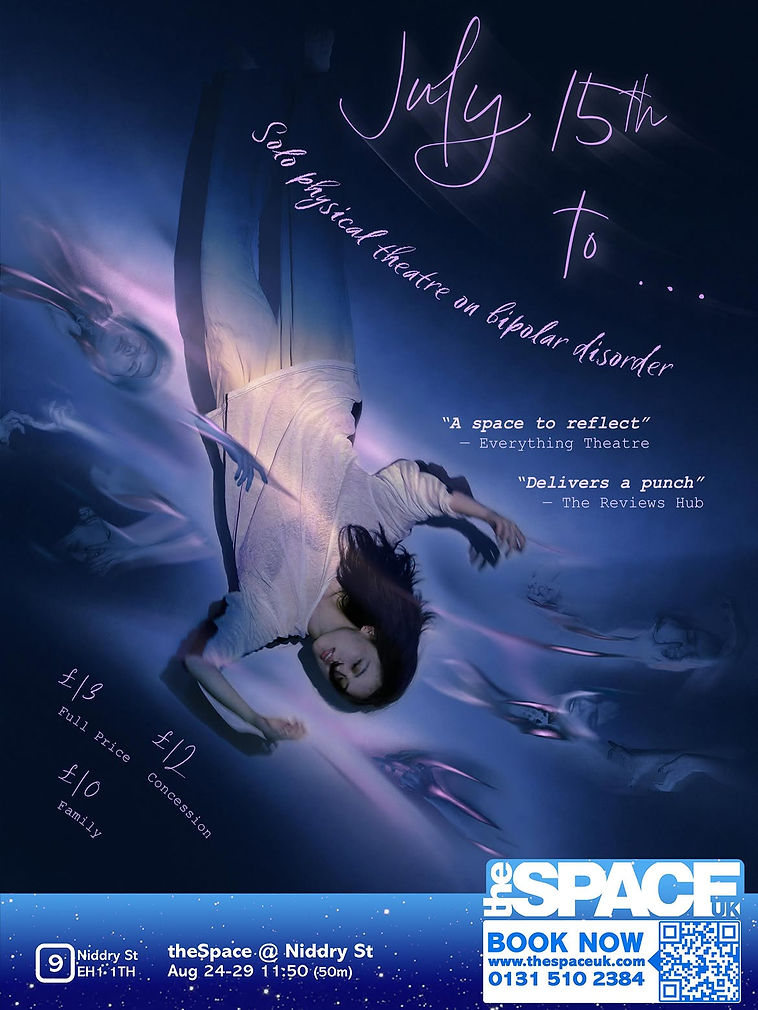
Director Angelina Voznesenskaia approaches the piece with skill and care, and the connection she’s found to the piece adds truth and understanding. Moreover, composers Xinyu Lu & Nik Sheva create a soundscape that’s heartfelt, hopeful, and contemplative, which always keeps you inside Ella’s experiences.
At the core of Chen’s play, inspired in part by producer Stephanie Chu's own experiences of mental health, are feelings of fear, guilt, and responsibility. These are powerful emotional triggers that can leave you paralysed, with memories being the cruellest of triggers. When Ella moves to London, it takes her away from the comfort she knows and her grandmother, an act that truly haunts her. Trying to find your own path in life is challenging enough, but the culture of family responsibility can make it harder to stay focused on what you want and what you need. The pressures we face can be compounded by a multitude of issues, problems, and experiences that can make it even harder to keep your mental health in balance. Ella is trying, as best as she can, to live her life but feels as though she’s constantly drowning. It’s not just the inability to ask ourselves whether what we are doing is right; it’s the fear of verbalising your feelings that can make it harder to forge connections and can push people further away.
"Trying to find your own path in life is challenging enough, but the culture of family responsibility can make it harder to stay focused on what you want and what you need."
There are no easy answers in how we understand bipolar disorder, and neither Chen, Chu, nor Voznesenskaia try to give the audience closure, as there can’t be any. What they do is use their platform to open a discussion, one that will, hopefully, encourage their audiences to understand bipolar disorder in a different light and possibly save lives.