
Don't hate the media, become the media. Jello Biafra
Alex Matraxia
goodnight ladies
19. British Shorts, Berlin | 2026
JAN 22–28
GOODNIGHT LADIES
Writer/Director: Alex Matraxia
Festival Screening:
Drama / Comedy / Mystery / Animation
Sun 24 | 21:00 | Sputnik Kino 1
Images © Wendyvision
JAN, 15, 2026

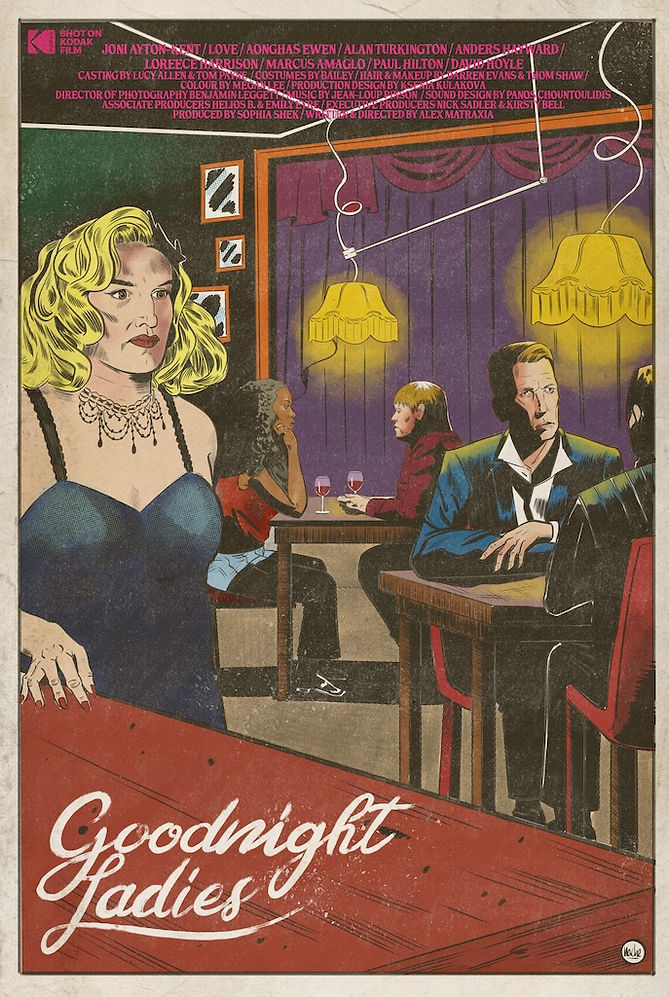
One night in a rundown drag bar, three tales unfold on the pressures of performance and second chances.
Hello Alex, thank you for taking this time to talk with us, it’s really great to chat with you again, last time we spoke was when Afterparty was part of BFI Flare, how was your time at the festival?
It was a while ago but I have fond memories. Screening at the BFI is always an experience, it’s a venue which means so much to the city’s film culture and Flare is a festival that means a lot to me.
Your previous short Dream Factory premiered at LSFF in 2024, and was also part of BFI Future Film Festival. What was that experience like for you?
They were both good experiences in different ways. LSFF feels more like a community of filmmakers who are trying out new things, it’s maybe a little more experimental in its sensibility, and that made it pretty perfect for Dream Factory which is more of an art film. It also screened with some other films shot on film, so it felt like being part of an even more niche community. BFI Future Festival is geared more for filmmakers under 25, to try and help them get their first foot in the door, so it feels more industry-focused, it’s a very different mood.
Congratulations on having your latest short is part of British Shorts, Berlin 2026. What does it mean to be at the festival with Goodnight Ladies?
I’ve never been to British Shorts before, but I’ve wanted to go for quite some time, I always like the look of their programming and it means an excuse to revisit Berlin. Also, Goodnight Ladies partially takes place in the world of nightlife, so it feels right for the film to finally screen in that city.
How important are festivals like these in providing a platform for short films?
Short films don’t have a very substantial afterlife, but festivals are really a great way to experience how other people experience your movie. They’re also the only way you’re going to have people watching your shorts on a big screen, which is important for reasons both aesthetic and social. I know they’re shorts, but I really try to make them look as cinematic as possible, and a lot of work goes into them from all departments, so I think it does justice to the films to have them screen in festivals. And I don’t mean my films, I mean all shorts, which are a labour of love in and of themselves.
Goodnight Ladies is supported by the Kodak Film Fund, what has it meant to you to get this type of support for your work?
Well it’s important because it means you can finish what you started. The Kodak film fund helped us with post-production costs, so it helped us complete the film, and I guess there’s something rather full-circle with it coming from Kodak, because they really helped us bring the film to life in the first place through some generous short-end donations.
Can you tell me how Goodnight Ladies came about, what inspired your screenplay?
It was a few different threads all coming together really. I have a deep love for films about theatre, about performance and backstage drama, things like Opening Night and All About Eve and Ken Russell’s The Boyfriend. I wanted to try and bring something from those movies, a sensibility maybe, into the context of queer nightlife. Goodnight Ladies is also an ensemble movie in miniature; it’s three different stories happening simultaneously one night in a drag bar, they’re all loosely tied together by the pressures of performance, professional or personal, on stage and off. Before I wrote it, I was finding it tiresome trying to write short films which adhered to a conventional short-form structure, usually involving the arc of a single protagonist. It just felt a bit laboured and conventional. I love digressive movies where the narrative is more like a baton, being passed around from character to character, and I thought it would be curious to try and do something similar in the short-form. It was an experiment in short-form narrative, but staged as a glitzy melodrama.
When you wrote Goodnight Ladies had you already had in mind who you wanted to play ‘Robert Lamore’?
I think a part of me constructed the whole film just as an excuse to work with David Hoyle again, who I’d worked with on Afterparty. David used to tell me that he always wanted a chance to play Norma Desmond in a Sunset Boulevard remake. The character of Robert Lamore, the has-been actor trying to make a comeback, was in some way a means of giving David what he wanted, but the character also draws from David as I’ve come to know him; his elegance, his anger and his wicked sense of humour.
What was it like working with David Hoyle on this film?
It’s always a pleasure. He’s a wonderful screen performer, remarkably photogenic and a true professional. He adds an extra something to the film, he gives it this little extra kick.
What was the message you wanted to say with Goodnight Ladies, and do you think you achieved it?
I don’t really do ‘messages’, the films emerge out of a desire to see the film, to tell a good story. I think going into it, or at least during the writing stage, it was intended as a film about the spaces between people, between strangers, kind of like Linklater’s Slacker. The multi-story structure emerged out of that intention. But then the film became more interested in the characters themselves, their own private dramas, and it began to model itself a little more on something like Magnolia. I don’t know if I achieved what I wanted to do with the movie, but it still flirts with some of the early ideas.
What’s the biggest changes to your filmmaking style been since your debut short?
That’s hard for me to say because I don’t really have an objective overview of my work. I think the writing is tighter, the style is a bit more considered, maybe more expressive. The big change that I’m aware of is probably my relationship with actors, because I really didn’t know how to work with actors on my first short, and I’ve really tried to develop that since.
How essential is the creative collaboration between you and your DOP Benjamin Leggett when working on a short like this?
Very. Working close with Ben was just integral to achieving the mood and tone we were after. The film is set in two different spaces within a single venue: the dressing rooms downstairs and the bar upstairs, and we had to work hard to give these spaces a distinct sense of atmosphere while also unifying them so that it all felt like part of one movie. We drew inspiration from some of the backstage footage in Cabaret; obviously it’s set in the 30s and people were smoking inside and the rooms are beautifully diffused with smoke, and we tried something similar with the backstage scenes in Goodnight Ladies because whenever I’ve spent time backstage in drag bars, it’s never minimal and pristine, there’s a really dense sense of texture to these spaces, and the haze just lifted all those textures from the room. I didn’t realise it when the film was first finished, but when I rewatch it now I realise how much I owe to Ben, because it really is so closely aligned to what was visually intended from the start.
"I think I’ve grown as a collaborator, and the most valuable things I’ve learned are about communication, about talking to people, taking care of your cast and crew."
When did you start working with your composer Jean-Loup Pinson on the score?
Quite early on. I sent him the script while it was still being drafted, and we had a loose discussion about possible instrumentation, about when we’d need non-diegetic music for certain scenes. Jean-Loup drafted some early suites which were useful to hear going into production, just to have some kind of tonal base when shooting, and he kindly visited the set to soak up some of the atmosphere. It’s a very mutual, growing and giving collaboration.
You also edited Goodnight Ladies, something you’ve done before, how does this influences the way you shoot?
It means I edit in-camera, which is helpful when shooting on a very tight budget because you know what you need and don’t need to make the edit work. The films are designed in quite specific ways and that seems to work best when anticipating the edit. Having said that I’d like to be a little looser in the future; while a storyboarded edit can be quite efficient in terms of telling the story, it does sometimes blind you from the good stuff in between the lines, the more ephemeral moments that happen on set that can really ground the film in something a bit more human.
How much does your commercial work, and your background in photography help guide your approach to your narrative filmmaking?
The commercial work occupies a very different part of me. But my photography informs the work quite a bit. Firstly I’ve always shot photos on film, and my interest in portraiture probably influences the way I like to shoot close-ups. My first approach to telling the story is usually visual, even though I write my own movies, and I think the weakest moments in my work are when I start relying on the dialogue too much do the storytelling.
What would you say have been the most valuable lessons you’ve taken from your short films that you’re going to carry over to your debut feature film Late Arrivals?
Probably my working relationship with people. I think I’ve grown as a collaborator, and the most valuable things I’ve learned are about communication, about talking to people, taking care of your cast and crew. It’s about people. Really, films are about people, both on and off screen.
Are you able to tell me anything about Late Arrivals?
I’ll just say, it’s a dark crime-comedy. Queer. 16mm. Black and white. If that sounds cool to you then please support the film, it needs some love. Get in touch.
And finally, what do you want your audiences to take away from Goodnight Ladies?
I hope they have fun with it. We’re rarely allowed to have fun at the movies anymore.